
With economic activity buoyed by expectations from the new elected government of "Prime Minister Narendra Modi, India is benefiting from a 'Modi dividend'," the Bank said in its twice-a-year South Asia Economic Focus report on Monday.
Even as the World Bank has revised India's growth figures by 0.4 percentage points as compared to its January forecast, India remains the fastest growing major economy in the world, the World Bank officials said.

The Janata Dal (United), an ally of the ruling Bharatiya Janata Party (BJP), has sought an extension in the tenure of the Joint Parliamentary Committee (JPC) scrutinising the bills proposing simultaneous elections. The party argued that the committee, which has only met once, requires more time for extensive consultations. Meanwhile, the Lok Janshakti Party (Ram Vilas), another BJP ally, has demanded a "special industrial package" for Bihar, highlighting the state's low per capita income compared to the national average.

President Xi Jinping has said that no one can ever stop Taiwan's reunification with China as he signed off 2024 amid growing anxieties in the country over the continued slowdown of the economy and the return of Donald Trump, who has threatened to impose punitive tariffs and trade measures against Beijing in his second term.

'Additionally, the significant employment multiplier will boost direct and indirect jobs of up to 1.1 million.'

What's different this time is that global financial stress -- which has its genesis in four policy choices made in recent years -- is juxtaposed with a more resilient real economy, observes Sajjid Z Chinoy, chief India economist at J P Morgan.

India needs another shot of difficult reform, of the kind only possible at gunpoint. Mr Trump holds that gun to our heads now. A drastic reduction in tariff protection, other elements of sarkari wet-nursing will force entrepreneurial India to become competitive again, argues Shekhar Gupta.

Nine Indian universities and institutions have secured a place among the world's top 50 in the QS subject-wise rankings, with the Indian School of Mines (ISM) Dhanbad claiming the highest position at 20th globally for Engineering-Mineral and Mining. Despite the success, some top institutions, including three IITs, two IIMs and JNU, have experienced a drop in their rankings. The QS World University Rankings by Subject, in its 15th edition, highlight India's growing higher education ecosystem in terms of both size and quality.

The external environment has worsened further. While the Finnish economy entered into a recession, Swedish economic growth also dipped. The Finnish gross domestic product (GDP) dropped 0.6 per cent in October-December, 2022. It was the second quarter of negative growth, which is a technical definition of recession.
India has already become 7th largest economy of the world, he said, adding that it is expected to become 5th largest economy soon.

Economy is slated to grow by 7.1 per cent this fiscal after the excellent monsoon although fiscal deficit may overshoot the target, credit rating agency Crisil said on Monday.

Mayaram also said as of now, a shutdown of the US government is not likely to have a major impact on the Indian economy.

The previous high GDP growth of 8.1 per cent was recorded in April-June quarter of 2016-17.

'The bull market cycle ran for five years. It's the end of that cycle.' 'The next cycle is a down cycle, and in that down cycle, you will see the Sensex falling from their highs of around 68,000 to maybe 40,000-50,000 at the bottom of the cycle.'
.jpg)
In 2008-09, the economy grew at 6.7 per cent despite poor farm sector growth of 0.4 per cent.

Equity markets will take cues from the US tariff related developments, global trends and trading activity of foreign investors this week, analysts said.
Parliament's approval of the Waqf (Amendment) Bill, a contentious piece of legislation aimed at reforming Waqf bodies, has sparked strong reactions from the opposition, who allege that the bill was "bulldozed" through Parliament. The bill, considered the government's most consequential legislation in its third term, was passed with comfortable majorities in both the Lok Sabha and Rajya Sabha despite opposition claims of a lack of consultation and an intrusion into religious affairs. Other notable bills approved during the session included the Finance Bill, Appropriation Bill, Immigration and Foreigners Bill, and Tribhuvan Sahkari University Bill. The session, which saw high productivity, also witnessed debates on issues such as economic distress, delimitation, and the three-language policy. While the government touted its achievements, the opposition criticized the government's approach and vowed to challenge the Waqf bill in court.
Finance Minister Pranab Mukherjee on Tuesday urged the states to strengthen PDS to enable the government insulate the poor from the adverse impact of inflation.

Wedding planner WedMeGood estimates that the average wedding budget has surged to Rs 36.5 lakh this year, with destination weddings averaging Rs 51 lakh.

The RBI on Wednesday cautioned that while the Indian economy appears capable of weathering the deterioration in geopolitical conditions amid the ongoing Russia-Ukraine war, it faces headwinds from global spillovers from geopolitical tensions, elevated commodity prices and moderating external demand. The RBI, however, did not tinker with the GDP growth projection made in April. It had slashed the GDP growth projection for the fiscal 2022-23 to 7.2 per cent from its earlier forecast of 7.8 per cent.

Ahluwalia's statement comes in the backdrop of Reserve Bank of India's tight monetary policy and high inflation.

Union minister Ashwini Vaishnaw countered Facebook founder Mark Zuckerberg on Monday on his claim that after the COVID-19 pandemic, most incumbent governments, including the one in India, lost elections in 2024, asserting that his statement was 'factually incorrect'.

The global rating agency expects the economy to pick up in the next two financial years.

Engineering and construction major Larsen & Toubro (L&T) reported a 25 per cent rise in net profit attributable to the owners of the company for the January-March quarter of 2024-25, owing to higher revenues and an exceptional gain. For the quarter under review, L&T posted a consolidated net profit of Rs 5,497.3 crore, while revenue rose 10.9 per cent year-on-year (Y-o-Y) to Rs 74,392.28 crore.
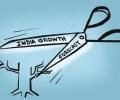
The Indian economy is estimated to grow at 7 per cent in the 2022-23 fiscal, down from 8.7 per cent a year ago, mainly due poor performance of mining and manufacturing sectors. As per the first advance estimates of national income released by the National Statistical Office (NSO) on Friday, the manufacturing sector output is estimated to decelerate to 1.6 per cent in the current fiscal from 9.9 per cent in 2021-22. Similarly, mining sector growth is estimated at 2.4 per cent in the current fiscal as against 11.5 per cent in 2021-22.

Analysts are warning of growing risks to the market's sustained momentum, and even to the possibility of consolidation at current levels. Domestically, markets are grappling with several challenges, including a slowing economy, as indicated by the latest GDP data for the July-September (Q2) quarter of 2024-25 (FY25), sticky inflation, fluctuations in the rupee, waning consumption, and high interest rates.

Six US Congressmen have written to the Attorney General of the United States expressing concerns over the Department of Justice's indictment of the Adani Group, alleging it jeopardizes relations with India. The letter, signed by Lance Gooden, Pat Fallon, Mike Haridopolos, Brandon Gill, William R Timmmons, and Brian Babin, criticizes the Biden administration's decision to pursue the case, arguing that it has no real injury to US interests and could negatively impact the strategic partnership between the US and India. The Congressmen call for an investigation into the DOJ's conduct and request records pertaining to the case.

India will place restrictions on foreign direct investment (FDI) in the national interest to ensure safeguards because of its location in a highly sensitive neighbourhood, Finance Minister Nirmala Sitharaman said during an interactive session at the Wharton Business School in the US on Tuesday. "I cannot blindly accept FDI simply because we need investment, unmindful of where it is coming from. "We want business, we want investment, but we also need some safeguards, because India is located in a neighbourhood that is very, very sensitive," Sitharaman said.

Notably Trump had withdrawn from the Paris Agreement immediately after his first inauguration in January 2017. Joe Biden reversed that decision later.

Amid growing fears of another global recession looming large, President Pratibha Patil today exuded confidence that India with its "strong fundamentals and resilience" will continue to grow economically.

The Prime Minister's Economic Advisory Council on Friday said the economy will grow by 8.5 per cent, up from a projected 8.2 per cent, and inflation will come down from double digits to 6.5 per cent by the end of 2010-11.
'The startup ecosystem, the government, and the owners of large pools of Indian capital need to actively support the creation of these local champions, not pull down the teams that are trying hard to get there.'

Seeking an apology from social media giant Meta for 'tarnishing' India's image, Bharatiya Janata Party MP Nishikant Dubey, who heads the Parliament's Standing Committee on Communications and Information Technology, said on Tuesday that the panel will summon the firm following its chairman's comments that India's ruling dispensation lost the Lok Sabha election last year.
India's economy grew 6.1 per cent in the fourth quarter of 2022-23, pushing up the annual growth rate to 7.2 per cent, official data showed on Wednesday.

The 2025 Champions Trophy promises to be a battleground for the world's top cricketers, with several players ready to leave their mark on the tournament.

With the rapid evolution of channels like quick-commerce and the emergence of ONDC, the Indian retail industry is 'cautiously optimistic' for 2025, in which new-age technologies such as AI and automation will play a crucial role, driving efficiency and personalisation.

Indian economy is expected to grow by 7.4 per cent in 2003-04 and the next year is also likely to be good for the country, according to a top official of Centre for Monitoring Economy.

Inflation is likely to drop to 5.4 per cent in FY 2014.

After the Covid-19 pandemic that derailed the economy since 2019, the Durga Puja festival in West Bengal is back with an estimated 20-30 per cent jump in festive spending. Retail sector is the key contributor to the state's Durga Puja economy which was Rs 32,377 crore in 2019, according to a British Council study conducted for the state government. Retail accounts for 85 per cent of the total puja economy and the rest is shared among pandal making, decoration, illumination, entertainment, advertisement, food & beverage and others.
